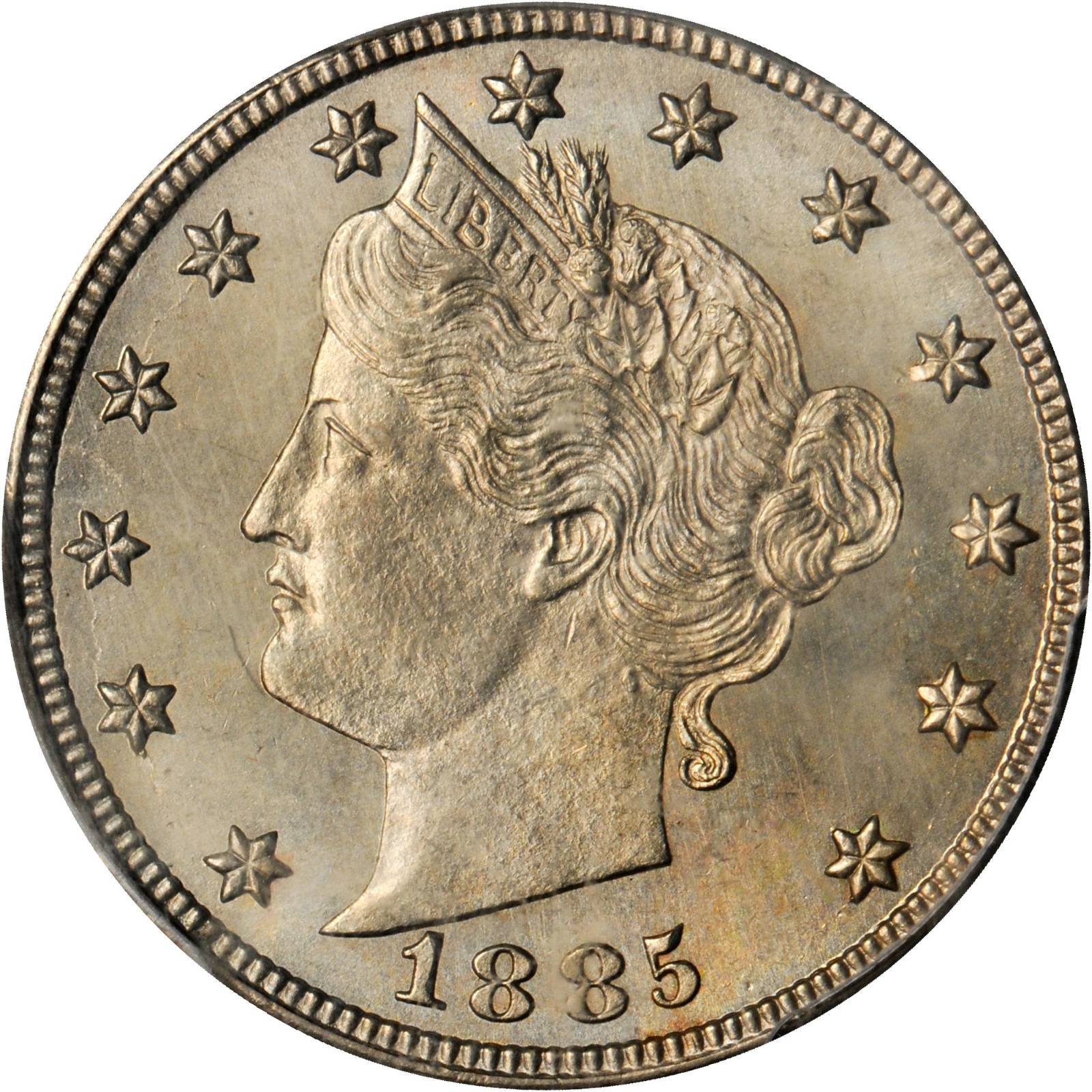
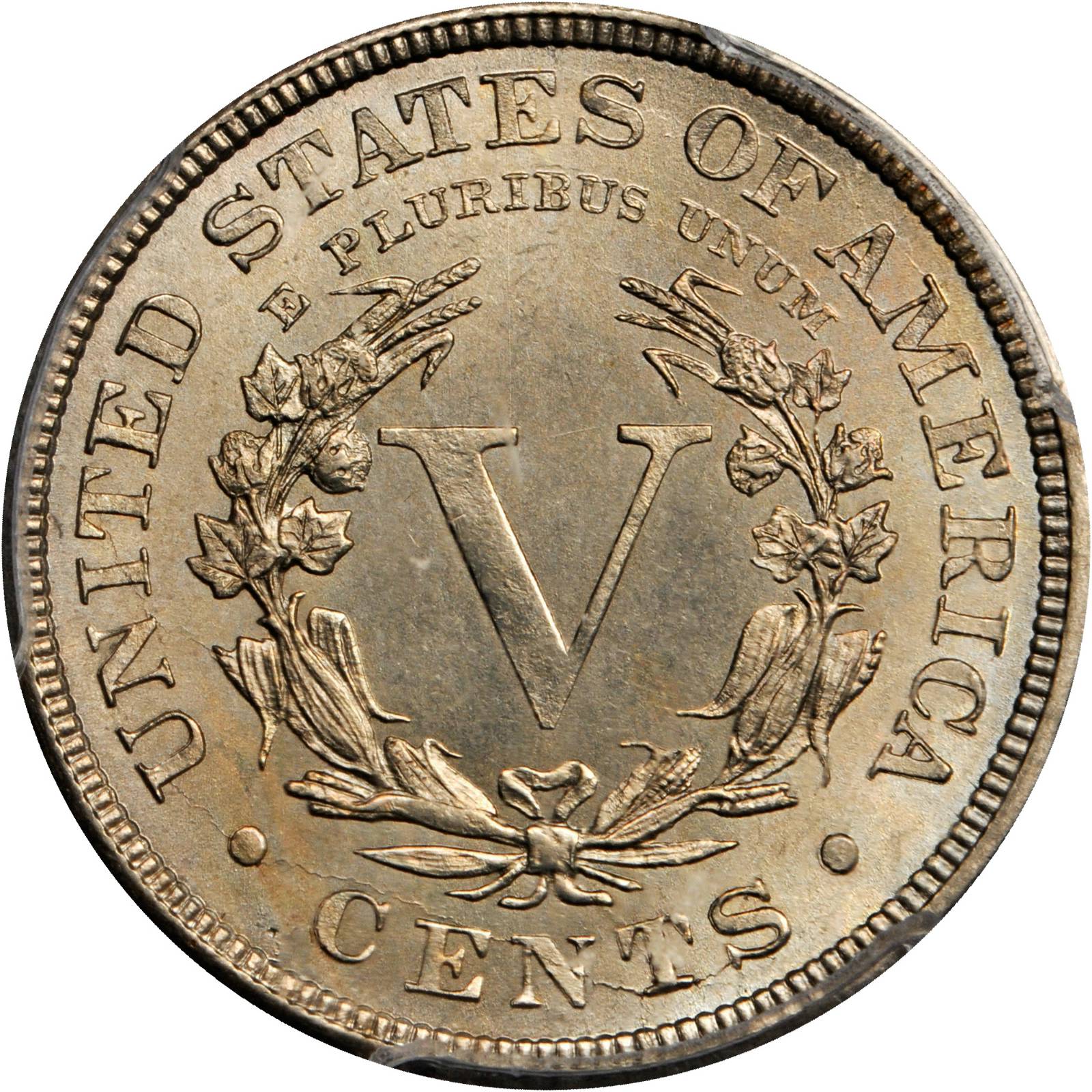
The Liberty Head or “V” nickel, designed by Charles E. Barber, replaced the Shield nickel in 1883 and ran for roughly thirty years. The obverse shows a classical head of Liberty; the reverse carries a large Roman numeral V inside a wreath.
The first 1883 coins were struck without the word CENTS — Mint officials assumed the size and metal made the value obvious. Because the coin’s diameter is close to that of the $5 gold piece, con artists gold-plated them (sometimes adding a reeded edge) and passed them as half eagles, earning them the nickname “racketeer nickels.” The Mint quickly corrected the oversight, adding CENTS below the V later in 1883, and that style continued through 1913.
Key facts
- Designed by: Charles E. Barber
- Issue dates: 1883–1913
- Composition: 75% copper, 25% nickel
- Diameter: 21.2 mm
- Weight: 5 grams
- Edge: Plain
The series has two design types: the one-year No CENTS type of 1883 and the With CENTS type of 1883–1913. A nickel’s purchasing power in this era was considerable, so most circulated heavily and survive well worn; problem-free coins in Fine through Extremely Fine are scarcer than the mintages suggest. Key dates include 1885 (the toughest in Mint State), 1886, 1894, and the low-mintage 1912-S (just 238,000, the first nickel struck at a branch mint). The famous 1913 Liberty nickel — only five known, struck unofficially at the Philadelphia Mint — is one of the most valuable U.S. coins of all, with recent sales in the multi-million-dollar range.
We actively buy Liberty Head nickels in every grade, from well-worn common dates to key dates, No CENTS examples, and sharp Mint State and Proof coins. Send photos for a free, no-obligation offer.