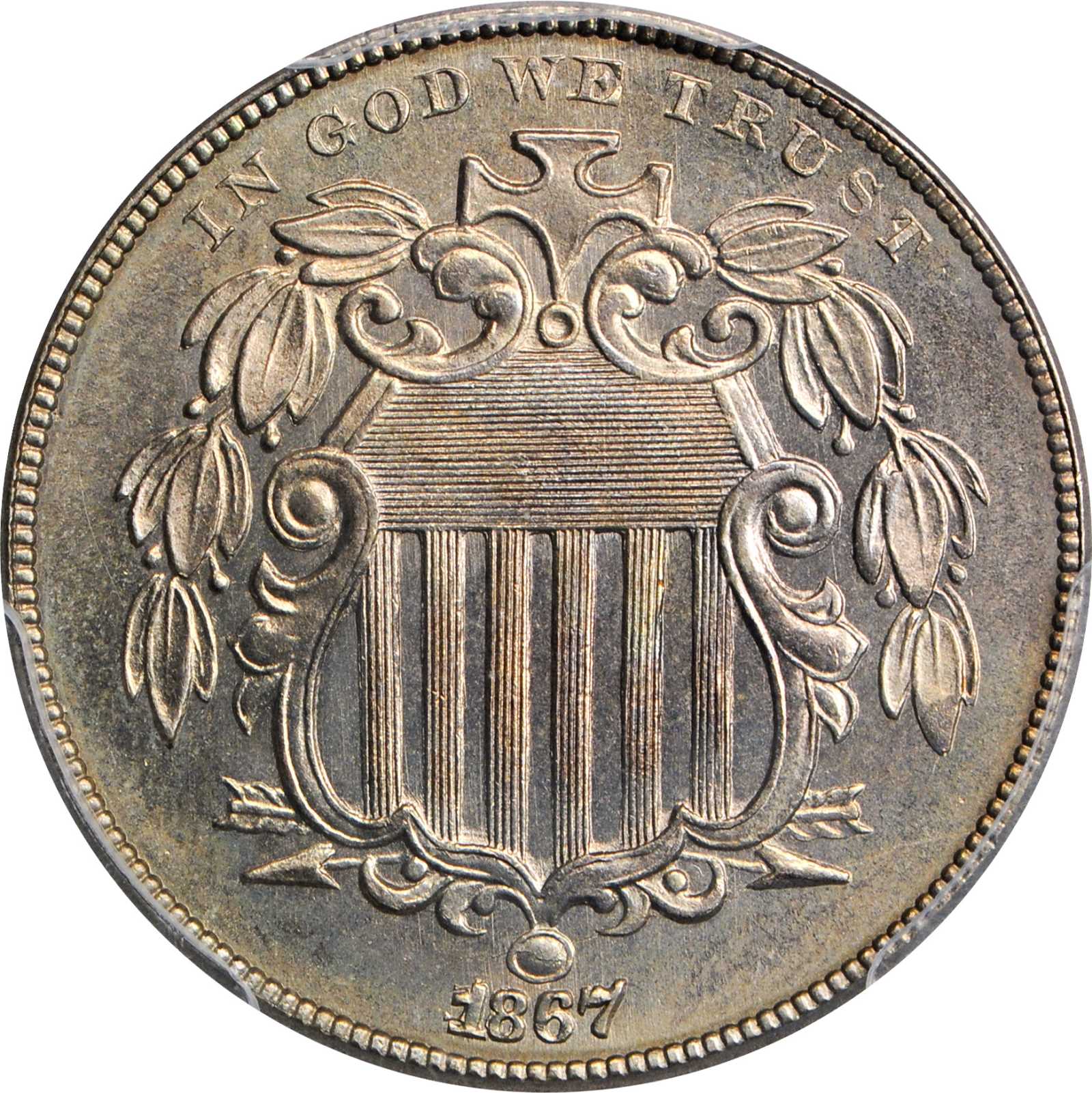
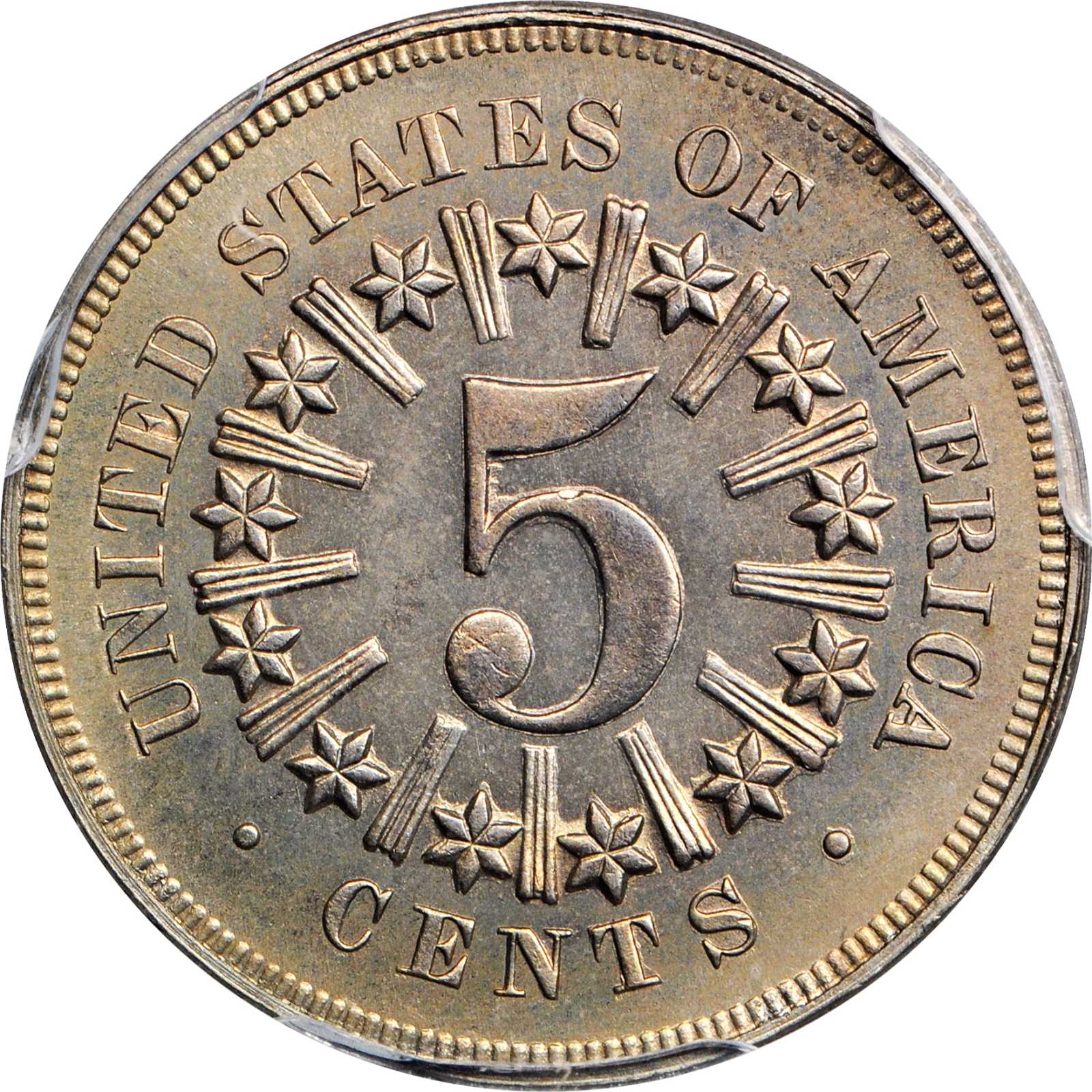
The Shield nickel was the first five-cent piece struck in copper-nickel, introduced in 1866. Widespread hoarding of silver and gold during the Civil War had driven hard-metal coins out of circulation, and the Mint turned to base-metal coinage — first a copper-nickel three-cent piece in 1865, then the five-cent nickel the next year. It effectively replaced the silver half dime, which lingered only through 1873.
Designed by James B. Longacre, the obverse shows a large shield adapted from his two-cent piece of 1864; the reverse displays a large numeral 5. The coin gave the five-cent denomination the nickname “nickel,” even though its alloy is three-quarters copper.
Key facts
- Designed by: James Barton Longacre
- Issue dates: 1866–1883
- Composition: 75% copper, 25% nickel
- Diameter: 20.5 mm
- Weight: 5 grams
- Edge: Plain
The series divides into two design types. The With Rays type of 1866 and early 1867 shows rays between the stars on the reverse; striking difficulties with the hard alloy led the Mint to remove the rays partway through 1867. Because only about 2,019,000 of the 1867 coins were made before the change, the 1867 With Rays is a scarce and sought-after issue, while the Without Rays type continued largely unchanged through 1883.
Shield nickels are notorious for soft strikes and die cracks — the hard alloy wore dies quickly, and repunched dates are common, including a famous doubled-date 1867 and an “18666” die of 1866. Key issues include the proof-only 1877 and 1878 (no circulation strikes were made those years) and the low-mintage 1879 through 1881. The high-mintage 1882 is the date most often seen in Mint State.
We actively buy Shield nickels in every grade, from well-worn common dates to key dates and sharp Mint State and Proof examples. Send photos for a free, no-obligation offer.