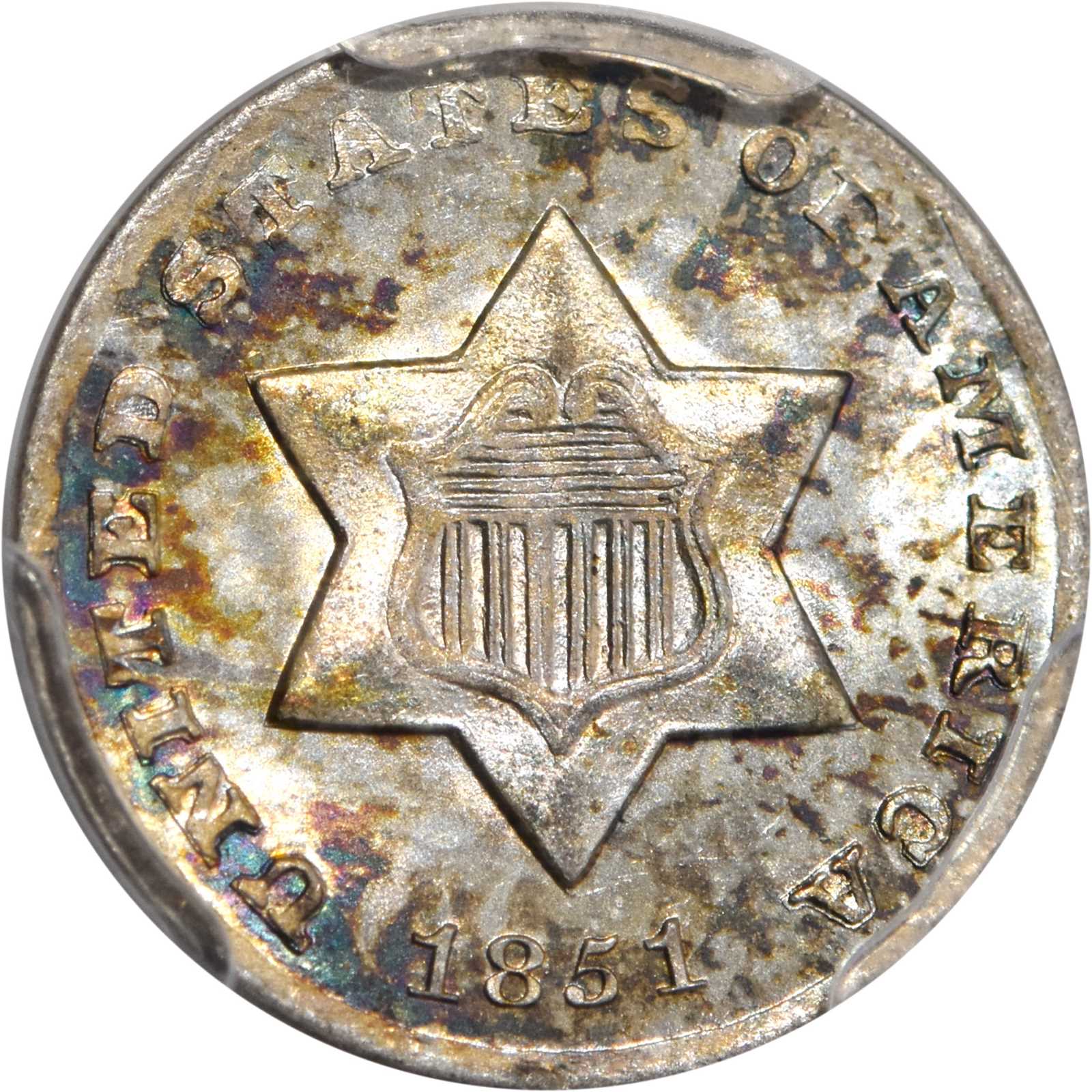
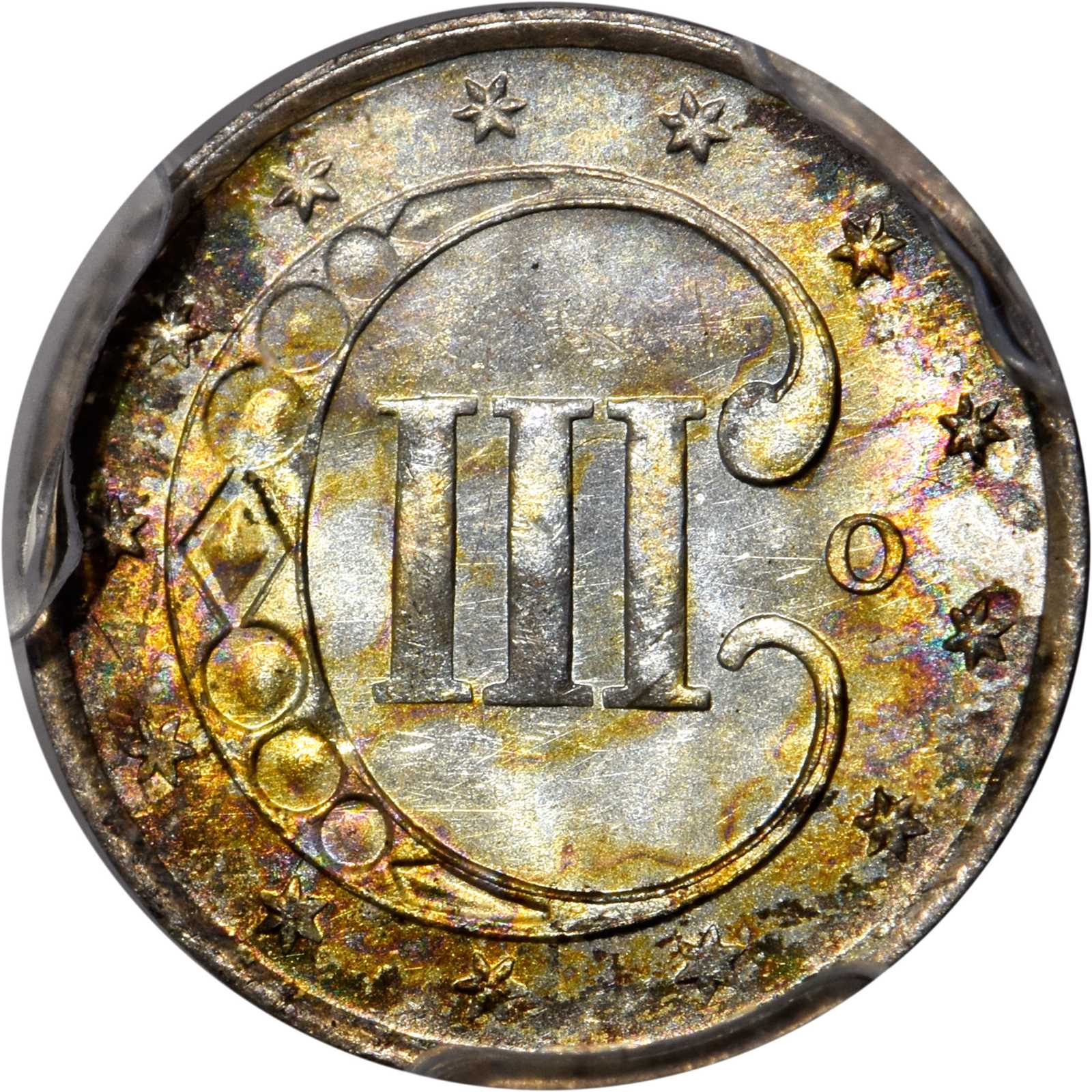
The silver three-cent piece — nicknamed the “trime” — appeared in 1851 and was the smallest silver coin ever struck by the United States. It was also the first U.S. circulating coin without a portrait of Liberty, showing instead a six-pointed star with a shield. It was introduced in part to make it easy to buy the new three-cent postage stamp.
Key facts
- Designed by: James B. Longacre
- Issue dates: 1851–1873
- Composition: Silver (75% Type I, 1851–1853; 90% Types II–III, 1854–1873)
- Diameter: 14 mm
- Weight: 0.80 grams (Type I); 0.75 grams (Types II–III)
- Edge: Plain
There are three minor design types: Type I (1851–1853, no outline to the star), Type II (1854–1858, two outlines), and Type III (1859–1873, one outline). All were struck at Philadelphia except the first year, when 720,000 were also made at New Orleans — the only mintmarked issue of the denomination. Production dropped sharply after 1862, and most later business strikes were melted in 1873; dates from the mid-1860s on are great rarities as business strikes and are usually collected as Proofs. Notable issues include the 1851-O, the scarce 1855, and the Proof-only 1873.
We actively buy silver three-cent pieces in every grade. Send photos for a free, no-obligation offer.